

It seems like a long time ago that we only had manual thermostats to work with. But now, with technological advancements, homeowners have more options than ever. Modern, advanced thermostats offer more precise temperature control and data sharing with the HVAC system.
Programmable and smart thermostats are two of the most popular choices. Both have their unique advantages and disadvantages. In this article, we will go through the pros and cons of programmable and smart thermostats that will help you decide which one is better suited for your condition.
Key Takeaways
- Temperatures in programmable thermostats can be set based on a schedule but require manual updates for change.
- Smart thermostats have advanced features like remote control, automation, and integration with smart home systems.
- Programmable thermostats are more affordable and simpler to use, but smart thermostats can provide long-term energy efficiency and convenience.
What is a Programmable Thermostat?
A programmable thermostat allows users to adjust specific temperatures across different days or different times of the day. It is also known as setback thermostats or clock thermostats.
As the temperature difference increases, the heating and cooling losses increase too. With these thermostats, the heating and cooling system can be adjusted automatically to a pre-set schedule.
Pros of Programmable Thermostats
- Operates automatically
- Budget-friendly option
- More customization
- Low energy cost if programmed correctly
- Simple interface
- Operable without Wi-Fi or apps
Cons of Programmable Thermostats
- No remote access
- Less flexibility
- Requires manual programming
- Little to no integration with smart home devices.
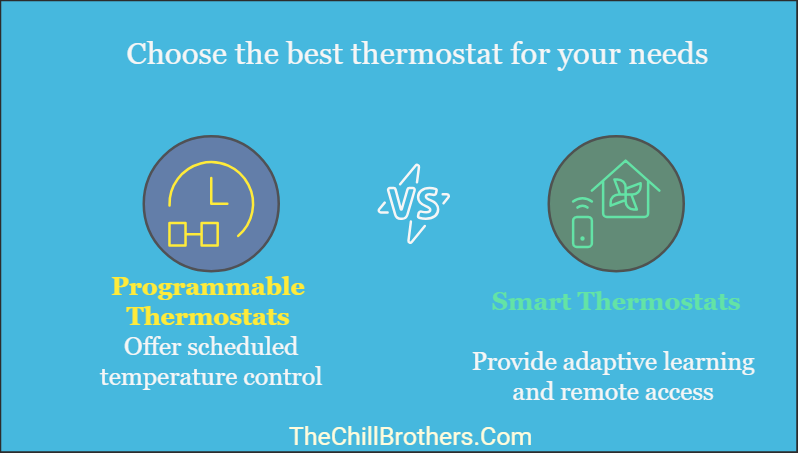
What is a Smart Thermostat?
A smart thermostat works similar to a programmable thermostat. It allows the user to control the temperature throughout the day within a schedule. It also contains additional features such as Wi-Fi connectivity and sensors.
Smart thermostats can learn temperature preferences, adjust settings automatically, and provide real-time data usage. Many smart thermostats can also be integrated with smart home ecosystems like Amazon Alexa or Google Assistant for voice control.
Pros of Smart Thermostats
- Remote access
- Automated energy savings
- Adjustability based on user preferences, occupancy, or weather changes
- Data tracking
- Geofencing (able to use phone’s location to adjust temperatures based on when you are arriving or leaving home)
Cons of Smart Thermostats
- High upfront cost
- Complex setup
- Overwhelming learning curve for some users
- Privacy concerns with the data collection aspect
Differences Between Programmable and Smart Thermostats
Both types of thermostats can maintain the perfect temperature at home. However, they offer very different levels of control, automation, and convenience. Some key differences between the two are:
Features | Programmable Thermostats | Smart Thermostats |
| Change of Schedule | Manual | Automatic |
| Remote Access | No | Yes |
| Wi-Fi Connectivity | No | Yes |
| Smart Home Integration | No | Yes |
| Learning Preferences | No | Yes |
| Energy Efficiency | Requires constant programming | Adjusts automatically |
| Cost | Cheaper | Expensive |
| Installation Complexity | Easier | Complex |
- Smart thermostats can automatically adjust the temperature based on your preferences and habits. Programmable thermostats can run on a set schedule but have to be changed manually for updates.
- You can only adjust the temperature at the programmable thermostat itself. Meanwhile, you can use smartphone apps to remotely control the smart thermostats.
- Programmable thermostats don’t connect to the internet. Smart thermostats require Wi-Fi to function.
- Programmable thermostats can’t integrate with smart home systems, but smart thermostats do.
- You can set smart thermostats to learn your preferences and schedule over time. Those can automatically adjust the temperature based on your past behavior. Programmable thermostats offer no such options.
- Programmable thermostats require consistent programming to be energy efficient. Smart thermostats can typically adjust themselves to be energy efficient.
- The cost of programmable thermostats is generally cheaper because of their basic features. Smart thermostats are more expensive.
- Programmable thermostats are easier to install, with fewer connectivity requirements. The installation of smart thermostats is more complex and can require professional help sometimes.
Which one Should You Choose, Programmable or Smart Thermostats?
The decision between a programmable and smart thermostat depends on your individual needs, budget, and technological preferences. Both types of thermostats offer the potential to save on energy costs by controlling your energy usage.
If you operate on a stable routine and don’t need much of an adjustment, you can go for programmable thermostats. They are also simpler to use and cost-effective.
If you are more tech-savvy and prefer the advanced energy-saving, automation, and remote control features, you can opt for the smart thermostat. Usually, they cost a little more than the programmable thermostats. However, in most cases, the energy savings over time can offset the cost.
Need help with the smart thermostat installation? Our professional team can assist you with installation, personalized setup, and expert advice so that your thermostat is properly installed, runs smoothly, and is integrated with your smart home devices. Skip the initial complexity and enjoy energy saving with seamless temperature control from day one.
Conclusion
Heating and cooling account for a significant portion of the utility bills. So, choosing the right thermostat can make a big difference. Programmable thermostats require less cost and high maintenance, while smart thermostats cost more and offer more features.
In conclusion, it is best to know what your preferences are in terms of operating the thermostats and financial resources to decide between a smart or programmable thermostat.

I’m Francis Kaspar, a 35-year-old HVAC technician with over 10 years of experience in the industry. I hold a certification in HVAC technology from Texas State Technical College, where I gained hands-on skills that shaped my career.
Currently, I’m working at The Chill Brothers, specializing in AC installation, repair, and energy-efficient solutions. Outside of work, I enjoy spending time with my wife and two kids.
I’m also passionate about sharing my HVAC knowledge written by articles that provide practical tips and tricks for homeowners.





 Google
  Facebook
  Trustindex