

We know how much of a headache it can be to size a furnace. We saw the struggle of Texas homeowners all the time while working on the chill brothers. Cause the wrong furnace size can break down home comfort.
So, to find the right furnace size, use a simple rule is to multiply your home’s square footage by 30 to 60 BTUs. Then you will get the perfect size furnace for your home.
How can you use this calculation right away? Let us share our process. So, you can cut down your sizing struggle even a little bit.
| TL;DR Furnace size depends on square footage, climate, and insulation, with most homes needing 30–60 BTUs per sq. ft., but a Manual J load calculation gives the most accurate result. |
Furnace Size by Square Footage
The easiest way to estimate furnace size is by looking at your home’s square footage. Most homes need between 30 and 60 BTUs per square foot. But the furnace strategy varies depending on your home.

If you calculate like that, then got those sizes by square feet:
| Home Size | Average BTU Range | Common Furnace Type | Best For |
| 800 sq. ft. | 30,000–40,000 BTUs | Gas or electric furnace | Apartments, small homes, condos |
| 1,000 sq. ft. | 40,000–50,000 BTUs | Gas furnace | Small single family homes |
| 1,100 sq. ft. | 45,000–55,000 BTUs | Gas or propane furnace | Older homes with average insulation |
| 1,300 sq. ft. | 50,000–60,000 BTUs | Gas furnace | Medium sized homes |
| 1,500 sq. ft. | 60,000–70,000 BTUs | Gas or propane furnace | Homes with standard 8 ft ceilings |
| 2,000 sq. ft. | 80,000–100,000 BTUs | Gas furnace | Larger homes and open layouts |
| 3,000 sq. ft. | 100,000–120,000+ BTUs | High capacity gas furnace | Large homes with high heating demand |
However, electric furnace sizing works differently in some cases because electric systems heat differently than gas units. But square footage still matters when calculating heating load.
You may also hear people ask about a furnace’s BTU per square foot. In most cases:
- Warm climates use around 30–35 BTUs per sq. ft.
- Moderate climates use around 35–45 BTUs per sq. ft.
- Cold climates can need 50–60 BTUs per sq. ft.
Before installing a furnace, check your local environment as well. If you want an instant answer, then use the BTU calculator, you will get a basic answer.
Key Factors That Affect Furnace Size
You can’t just say or think this is the correct furnace size. Cause there isn’t any fixed furnace size, it varies depending on some factors like:
Climate & Temperature Zone
Texas has very different heating needs depending on the city. North Texas has much colder winters than the South. Like the winter lows often fall between 30°F and 40°F, and cold fronts can push temperatures below 20°F. Because of this spread, furnace sizing varies across the state.
Home Insulation & Energy Efficiency
Insulation makes a big difference in how hard your furnace has to work. Many older Texas homes were built with lower insulation standards. We often use R-11 to R-13 in walls and thinner attic insulation. Newer homes are better, usually reaching R-15 to R-21 in walls and R-30 or higher in attics. That’s impact on the furnace size a lot.
Windows, Doors & Sun Exposure
Windows and doors are one of the biggest sources of heat loss. A single pane window can lose 2 to 3 times as much heat as modern double pane glass. In many homes, around 25% to 30% of heat loss occurs through windows and doors if they are not well sealed.
So, if your house is packed with windows and doors every here and there, then you need a much bigger furnace then other.
Ceiling Height & Home Layout
Texas homes often have high ceilings and open floor plans. This design is great for summer airflow and cooling, but it changes heating needs in winter. A standard furnace size is based on 8 foot ceilings. When ceilings are 10 to 12 feet high, the heating load can increase by 15 to 25% because there is more air to warm.
Ductwork & Airflow Efficiency
Even smaller leaks can increase energy use by 15% to 25%. This is even more important in Texas, where attic ductwork often experiences extreme temperature swings. In winter, they can drop close to freezing in North Texas. Over time, this weakens seals and reduces efficiency.
If you’re unsure about the sizing, then call a professional before repairing or replacing your furnace. Cause it is better to get it done right the first time rather than regret later.
What Happens If You Get The Wrong Furnace Size?

Both oversized and undersized furnace systems can cause comfort issues, higher utility costs, and shorter furnace lifespans. An oversized furnace can cause issues like:
- Short cycling issues
- Temperature swings between rooms
- Uneven heating
- Increased wear and tear
- Higher energy bills
- Higher watt usage
- Poor humidity control
- Extra strain on the blower motor and ignition system
On the other hand, an undersized furnace has the opposite problem. It does not provide sufficient heating capacity for the home’s heating solutions. So, it creates:
- Cold air from vents
- Inconsistent heating
- Rooms that never feel warm enough
- Higher monthly heating bills
- Longer furnace runtime
- Faster system wear
- Premature system failure
How To Determine Furnace Size?
The Chill Brothers run through some steps to find out the right size furnace for your home, such as:
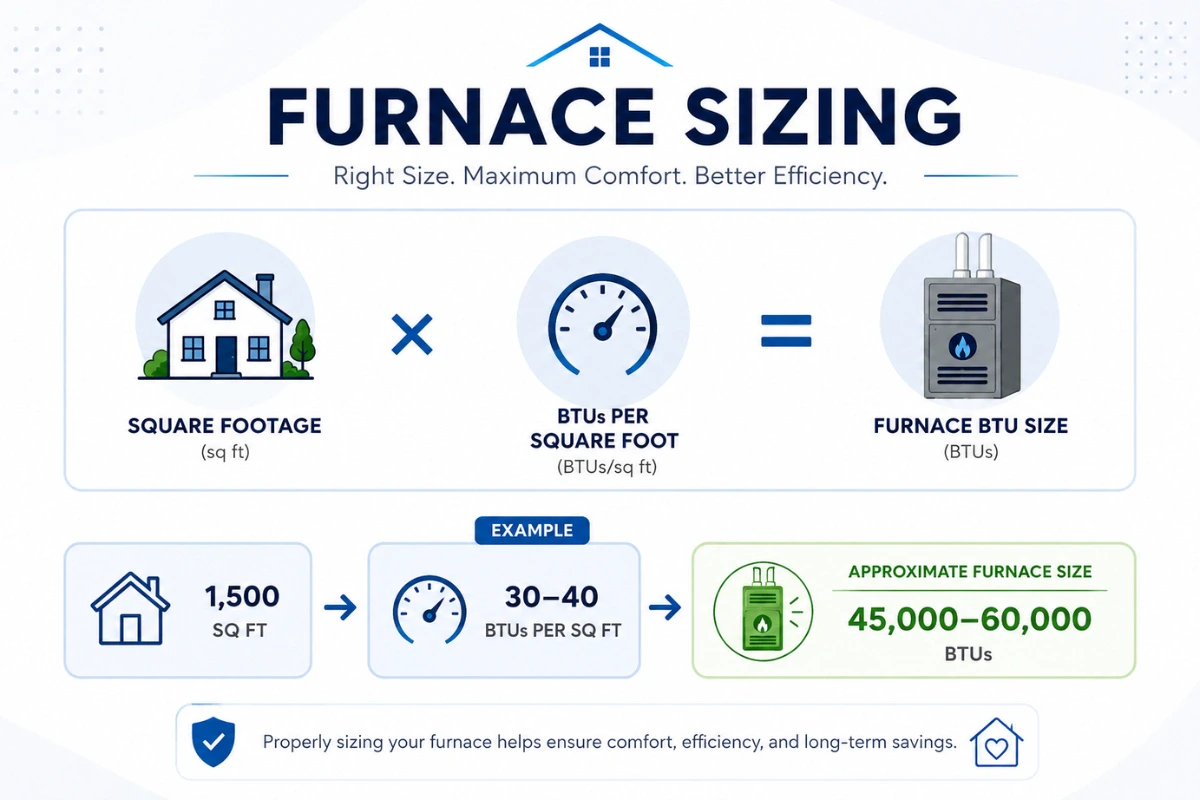
Use The Square Footage Method
One of the most common ways to estimate furnace size is by using your home’s square footage. This method gives a quick idea of the furnace BTU rating you may need.
Most homes need around 30 to 60 BTUs per square foot.
But it may change based on your climate zone, insulation quality, ceiling height, and overall heat loss. Once we got the BTU, we use this formula:
Furnace BTU Size=Square Footage×BTUs Per Square Foot
Then we calculate it like:
- A 1,500 sq ft home in a mild climate may need a 45,000 to 60,000 BTU furnace.
- A 2,000 sq ft home in a colder climate may need an 80,000 BTU furnace.
This method is fast, but it does not account for factors such as air leakage, drafty windows, or ductwork efficiency.
Check Your Climate Zone
Climate has a major impact on residential furnace sizing. Homes in colder areas need higher heating capacity because the furnace works harder during winter. A house in a warm California climate will usually need fewer BTUs than a similarly sized home in a colder region with heavy seasonal heating demand.
Cold climate heating needs often require:
- Higher furnace BTU output
- longer heating cycles
- stronger heat retention
Climate based BTU scaling helps prevent energy waste and uneven heating during very cold weather.
Use A Manual J Load Calculation
A load calculation is the best way to find the right furnace size for your home. Our HVAC contractors use this method to measure how much heat your home actually needs.
The most common method is called a Manual J load calculation. It is more accurate than simple online calculators or square footage estimates. Cause Manual J considers the overall condition of your home. It does not rely on just one number.
During the process, an HVAC contractor checks things like:
- square footage
- insulation quality
- climate zone
- ceiling height
- window and door placement
- air leaks and airflow
For example, 2 homes may both be 2,000 sq. ft. But one may need a larger furnace because it has poor insulation, old windows, or higher ceilings.
This is a faster method that gives a general estimate. Manual J is more detailed and usually more accurate for residential furnace sizing.
If you are overwhelmed, using online furnace calculators can help with a rough estimate. But they usually miss important details about your home. That is why using professional load calculations is best and gets you the right size.
Final Thoughts
You need to get the right size furnace for your home. A furnace that is too big will waste energy and cycle too often. A furnace that is too small will struggle to keep your home warm.
Square footage gives you a starting point. But it is not the full answer. You need to factor in your climate and home environment, too. That’s why it’s best to hire professionals like the chill brothers and get things done. They will install your furnace within a few hours.
Frequently Asked Questions
How big of a house can a 60,000 BTU furnace heat?
A 60,000 BTU furnace can usually heat about 1,200 to 1,800 sq. ft. of space. The exact size depends on insulation, ceiling height, and climate. In colder areas or older homes, it may only cover the lower end of that range.
What size furnace does a 2,000 sq ft house need?
A 2,000 sq. ft. house usually needs around 80,000 to 100,000 BTUs. Well insulated homes in mild climates may stay closer to 80,000 BTUs. Homes with poor insulation or colder winters may need closer to 100,000 BTUs.
How many square feet will an 80,000 BTU gas furnace heat?
An 80,000 BTU furnace can typically heat about 1,600 to 2,400 sq. ft. of space. The actual coverage depends on insulation quality, air leakage, window type, and local weather conditions.

I’m Francis Kaspar, a 35-year-old HVAC technician with over 10 years of experience in the industry. I hold a certification in HVAC technology from Texas State Technical College, where I gained hands-on skills that shaped my career.
Currently, I’m working at The Chill Brothers, specializing in AC installation, repair, and energy-efficient solutions. Outside of work, I enjoy spending time with my wife and two kids.
I’m also passionate about sharing my HVAC knowledge written by articles that provide practical tips and tricks for homeowners.





 Google
  Facebook
  Trustindex