
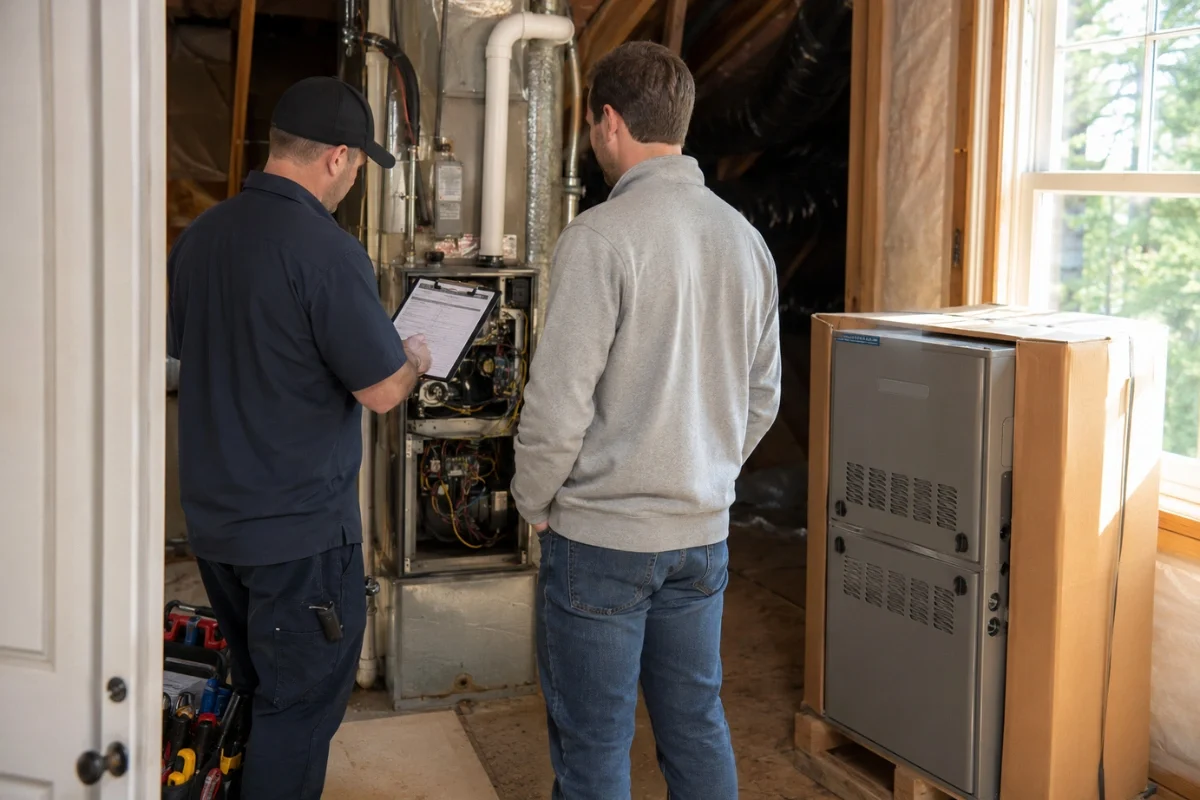
Replacing a furnace in Tomball, TX, typically costs between $4,500 and $10,500. Most homeowners spend $6,500 to $8,500 for a professionally installed gas furnace.
But one thing we see in the field all the time is that furnace replacement costs can vary a lot from home to home.
Even houses that look the same on the outside can have very different setups inside. Some have older ductwork. Some need resizing for the new system. Others have airflow or insulation issues that change the job completely.
That’s why the Chill Brothers never rely on square footage alone. A proper in-home inspection provides a much clearer, more accurate price.
| TL;DR: Replacing a furnace in Tomball typically costs $4,500 to $10,500, with most homeowners paying $6,500 to $8,500 for a professionally installed gas furnace. Your final cost depends on factors like furnace size, AFUE rating, labor, ductwork, and installation requirements. The best way to get an accurate estimate is through an in-home inspection and a Manual J load calculation, rather than relying on square footage alone. |
Is It Better to Repair or Replace a Furnace?
The answer depends on 3 things:
- The Age Of Your Furnace
- The Cost Of The Repair
- How efficiently is it running.
While a simple repair can keep a newer furnace going for years, putting money into an aging system isn’t always the best investment.
One guideline many of our HVAC professionals use is the $5,000 Rule.
Multiply the age of your furnace by the estimated repair cost. If the total is more than $5,000, replacing the furnace is usually the smarter financial decision.
For example:
- A 10-year-old furnace with a $300 repair equals $3,000. Repairing it is generally the better option.
- An 18-year-old furnace with a $400 repair equals $7,200. At that point, replacement often provides better long-term value.
It’s also important to think beyond today’s repair bill. Older furnaces are less efficient and typically cost more to operate. A new high-efficiency furnace can use less fuel, provide more consistent heating. It reduces the chances of unexpected breakdowns during the winter.
Signs It’s Time to Replace Your Furnace
Most furnaces don’t stop working overnight. Instead, they give you warning signs that they’re nearing the end of their lifespan. If you’re noticing one or more of the issues below, it may be more cost-effective to replace your furnace than continue repairing it.

Your Furnace Is 15 to 20 Years Old
Most gas furnaces last 15 to 20 years with regular maintenance. As they age, their efficiency declines, parts wear out, and breakdowns become more common. Even if an older furnace still works, it may cost much more to operate than a newer high-efficiency model.
You’re Paying for Frequent Repairs
An occasional repair is normal, but if your furnace needs service every winter, those repair bills can add up quickly. Investing in a new system often makes more financial sense than continuing to repair aging equipment.
Your Heating Bills Keep Going Up
If your gas bills continue to rise even though your heating habits haven’t changed, your furnace may be losing efficiency. Older systems have to work harder to produce the same amount of heat, which increases monthly energy costs.
Some Rooms Never Feel Warm
Uneven heating is a common sign that your furnace is struggling to distribute warm air throughout your home. If some rooms stay comfortable while others always feel cold, your heating system may no longer be performing as it should. A broken furnace gives the same headache as a broken HVAC.
Your Furnace Makes Unusual Noises
Banging, rattling, squealing, or grinding noises aren’t part of normal furnace operation. These sounds often indicate worn or failing internal components that can lead to more expensive repairs if ignored.
You Notice a Yellow Burner Flame
A properly operating gas furnace should produce a steady blue flame. A yellow or flickering flame may indicate incomplete combustion. This can be a sign of a ventilation problem or other combustion issue that should be inspected promptly.
The Heat Exchanger Is Cracked
A cracked heat exchanger is one of the most serious furnace problems. It can affect your furnace’s safe operation and is often expensive enough that replacing the furnace is the more practical long-term solution.
Airflow Feels Weak
If you notice less air coming from your vents than before, your furnace may be struggling to move heated air through your home. Weak airflow can make rooms feel colder, increase heating times, and reduce overall comfort.
What Affects Furnace Replacement Cost?
The cost to replace a furnace isn’t based solely on the equipment. Several factors determine your final price, which is why two homes in Tomball can receive very different quotes. Cause different homes need different furnace strategies.

Some of the biggest cost factors include:
- Furnace size (BTU)
- AFUE efficiency
- Brand
- Labor
- Ductwork condition
- Gas line or venting upgrades
- Electrical work
- Smart thermostat
- Permits and inspections
The best way to get an accurate quote is with an in-home evaluation. A professional contractor can figure out your heating needs, inspect your existing system, and recommend the right furnace for your home.
Furnace Replacement Cost In Tomball, TX, Depends On Factors
There is no right answer for furnace replacement cost in Tomball, but still, we see some common costs while working for 5 years in the area-
Furnace Replacement Cost by Furnace Type
Gas furnaces are the most common and typically cost between $4,500 and $8,500 installed in Tomball. And the others can cost you like this-
| Furnace Type | Average Installed Cost |
| Electric Furnace | $3,500–$6,500 |
| Gas Furnace | $4,500–$8,500 |
| High-Efficiency Furnace (95%+ AFUE) | $6,500–$10,500 |
| Two-Stage Furnace | $6,000–$9,500 |
| Variable-Speed Furnace | $7,500–$12,000 |
by AFUE Rating
AFUE (Annual Fuel Utilization Efficiency) measures how efficiently your furnace converts fuel into heat. The higher the AFUE rating, the less energy is wasted during operation. So, it affects the replacement cost a lot like-
| AFUE Rating | Average Installed Cost |
| 80% AFUE | $4,500–$6,500 |
| 90–92% AFUE | $5,500–$7,500 |
| 95–96% AFUE | $6,500–$9,000 |
| 97%+ Premium Furnaces | $8,000–$10,500+ |
Why does AFUE matter in Tomball?
The right AFUE rating is not always about choosing the furnace with the highest efficiency. It is about finding the system that makes sense for your home, heating habits, and budget.
Tomball does not experience long, harsh winters like those in the northern states, but your furnace still works hard during cold fronts and chilly winter nights. Since heating demand is usually seasonal, paying more for the highest-efficiency model may not always yield the best return.
For example, if you only run your furnace for a few months each year, an 80% or 90% AFUE system may provide enough comfort without the higher upfront cost. But if you plan to stay in your home for many years or want to reduce natural gas usage, a 95% or higher AFUE furnace may offer better long-term value.
During an in-home evaluation, we look beyond the furnace efficiency rating. We also check your home’s insulation, ductwork condition, heating needs, and how often your system runs.
These details help determine whether upgrading to a higher-efficiency furnace will actually save you money over time or if a lower-cost option makes more sense for your home.
By Home Size
Your home size can give you a general idea of what furnace size you may need, but it should not be the only factor used to determine replacement cost.
A common mistake homeowners make is choosing a furnace based only on square footage. Two homes with the same size can require completely different heating systems depending on insulation, window quality, ductwork, ceiling height, and air leakage.
That is why HVAC professionals use a Manual J load calculation before recommending a furnace. Manual J evaluates your home’s actual heating needs and helps determine the optimal furnace size for greater efficiency, comfort, and performance.
Here is a general cost range based on home size:
| Home Size | Average Furnace Replacement Cost |
| Under 1,500 Sq. Ft. | $4,000–$7,000 |
| 1,500–2,000 Sq. Ft. | $4,500–$8,000 |
| 2,000–2,500 Sq. Ft. | $5,500–$9,000 |
| 2,500–3,000 Sq. Ft. | $6,500–$10,000 |
| 3,000+ Sq. Ft. | $8,000–$12,000+ |
Labor Cost to Replace a Furnace in Tomball
Labor cost is $1,500 to $3,500 for professional furnace installation. But yes, it depends on the job’s complexity.
A straightforward furnace replacement is usually less expensive than an installation that requires ductwork modifications, new venting, or electrical upgrades.
But, don’t get shocked just by seeing the labor cost. It costs that much cause it includes many things, such as:
- Removing and disposing of the old furnace
- Installing and securing the new furnace
- Connecting the gas line, electrical wiring, and thermostat
- Installing or modifying the venting system if needed
- Testing airflow and system performance
- Checking for gas leaks and verifying safe operation
- Calibrating the thermostat
- Final safety inspection and system startup
Some contractors also include permit fees, haul-away, and the first system inspection in their installation price, while others charge for these separately.
But not every furnace replacement is the same. Two homes can install the same furnace but have very different labor costs.
For example, labor costs may increase if your installation requires:
- Ductwork repairs or modifications
- Gas line upgrades
- New exhaust venting
- Electrical panel or wiring updates
- A new thermostat
- Installing the furnace in a tight attic or crawl space
- Bringing an older system up to current building codes
These additional tasks take more time and materials, which increases the overall installation cost.
How Long Does Furnace Installation Take?
Most standard furnace replacements in Tomball take 1 full day, or about 4 to 8 hours. More complex projects that involve ductwork changes, relocating the furnace, or upgrading gas and electrical connections may take one to three days.
Before leaving, the installation team should test the entire system, verify that it’s operating safely, and make sure your home is heating properly. They should also show you how to use your new thermostat and answer any questions about your new furnace.
Permit Requirements for Furnace Replacement in Tomball

When replacing a furnace in Tomball, a permit is required for most installations. The permit itself usually costs $100 to $300, and many HVAC companies include that fee in their estimate. If it’s not listed, it’s worth asking before you approve the job.
After installation, the city may inspect the new furnace to ensure everything was installed correctly.
They’ll check items like the gas line, venting, electrical connections, and other safety requirements. It’s simply a way to confirm the system meets current building codes and is safe to operate.
Some homeowners are tempted to skip the permit to save a little money.
But, in our experience, that’s rarely worth the risk. An installation that isn’t permitted can create problems later if you sell your home, file an insurance claim, or need warranty work.
It may also mean paying to correct code violations that could have been avoided from the start.
A licensed HVAC contractor will usually handle the permit process for you, schedule any required inspections, and ensure the installation meets local code requirements. It’s one less thing you have to worry about and helps ensure your new furnace is installed correctly from day one.
Warp Up
A furnace replacement is more than installing new equipment. It’s about choosing the right system for your home and having it installed correctly. A professional in-home evaluation can help you understand your options, avoid unnecessary costs, and make a confident decision.
Frequently asked questions
How long does furnace replacement take?
Most furnace replacements are completed in one day, usually within 4 to 8 hours. If your home needs ductwork modifications, gas line upgrades, or electrical work, the installation may take one to three days. Before leaving, the HVAC technician should test the system, verify it’s operating safely, and make sure your home is heating properly.
Does homeowners insurance cover furnace replacement?
In most cases, no. Homeowners insurance generally doesn’t cover furnace replacement due to normal wear and tear or old age. However, if your furnace is damaged by a covered event, such as a fire, lightning strike, or severe storm, your policy may help pay for the replacement. Check with your insurance provider to understand what’s covered.
Can I replace my furnace without replacing my AC?
Yes. If your air conditioner is still in good condition and compatible with the new furnace, you can replace the furnace by itself. During an inspection, your HVAC contractor will check whether the existing indoor coil, blower, and other components will work properly with the new system before making a recommendation.
Is a high-efficiency furnace worth it in Texas?
It depends on your home and how long you plan to live there. Since Tomball has relatively mild winters, many homeowners find that an 80% or 90% AFUE furnace provides plenty of comfort. If you plan to stay in your home for many years or want to reduce natural gas usage, a 95% or higher AFUE furnace may be worth the higher upfront investment.
Should I replace my thermostat when replacing my furnace?
It’s often a good idea, especially if your thermostat is older or doesn’t support your new furnace’s features. A modern programmable or smart thermostat can improve comfort, help your furnace run more efficiently, and give you better control over your heating schedule.

I’m Francis Kaspar, a 35-year-old HVAC technician with over 10 years of experience in the industry. I hold a certification in HVAC technology from Texas State Technical College, where I gained hands-on skills that shaped my career.
Currently, I’m working at The Chill Brothers, specializing in AC installation, repair, and energy-efficient solutions. Outside of work, I enjoy spending time with my wife and two kids.
I’m also passionate about sharing my HVAC knowledge written by articles that provide practical tips and tricks for homeowners.



 Google
  Facebook
  Trustindex