
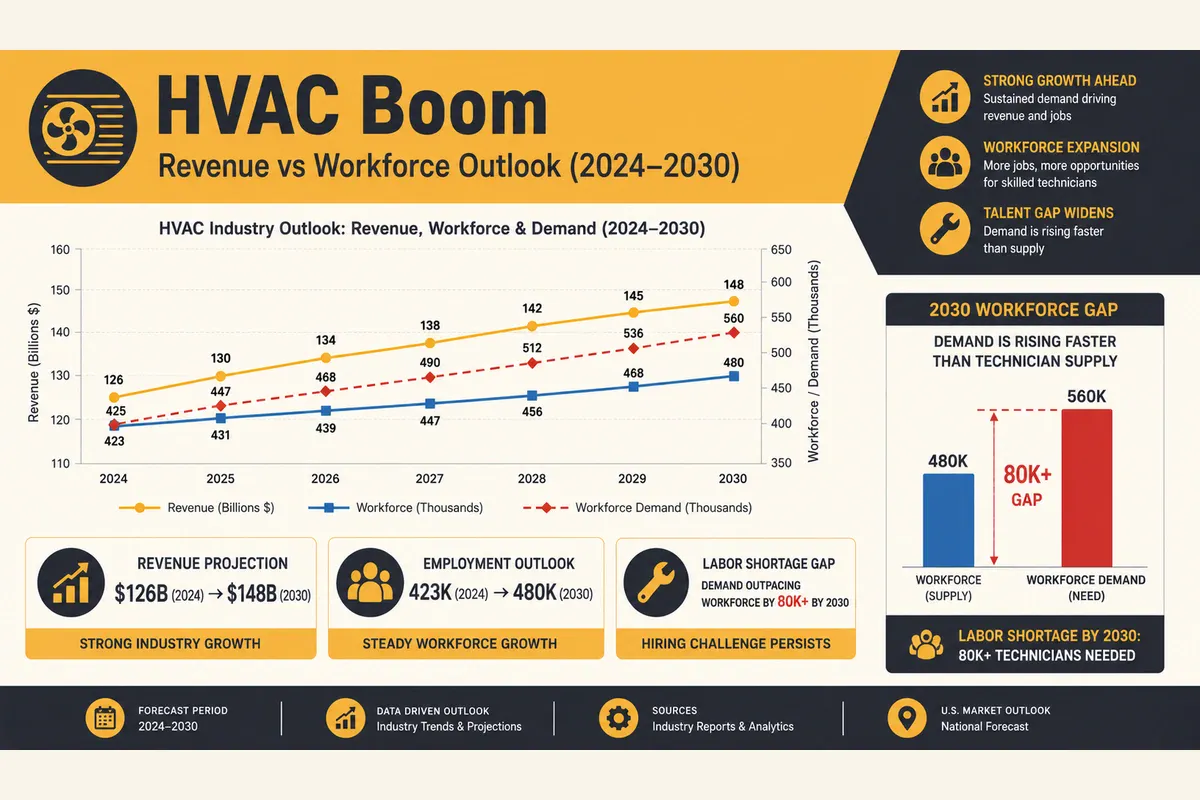
The US HVAC industry is already one of the biggest in the world, with revenue projected to reach $132.90 billion by the end of 2026 and about $148 billion by 2030. At the same time, copper prices have climbed 25 percent, equipment lead times can stretch to six weeks, and refrigerant phaseouts are reshaping how systems are designed, installed, and serviced.
For contractors, owners, and managers, the real question is not just whether HVAC is growing, but how that growth translates into opportunity. How big is the US HVAC market today, how many companies and technicians are competing in it, and what does the BLS job outlook through 2034 really show? This report breaks down market size, contractor and workforce numbers, wage trends, and the coming labor crunch so you can plan hiring, pricing, and expansion with real data, not guesses.
Key Takeaways
|
Current Market Size and Revenue
Revenue streams indicate the industry’s current strength. The HVAC section in the U.S. isn’t just growing, it’s outpacing other global markets.

Number of HVAC companies in US
There are roughly 120,000 to 170,000 HVAC companies operating across the United States. Most industry sources put the number at around 120,000 active heating and air conditioning contractors. Although the total varies depending on whether small independent businesses and specialty contractors are included.
The U.S. HVAC industry is dominated by local businesses rather than large national brands. In fact:
- More than 75% of HVAC companies are small, independently owned businesses.
- Around 40% have their own website, while 100,000+ contractors still rely mainly on referrals, repeat customers, and local advertising.
- California, Texas, and Florida have the largest number of HVAC contractors due to their large populations, hot climates, and strong demand for heating and cooling services.
Even with thousands of HVAC businesses across the country, demand continues to outpace supply in many HVAC markets. Skilled technicians remain in short supply, which is why reputable contractors often stay busy throughout the year, especially during peak summer and winter seasons.
Revenue Generated by the U.S. HVAC Industry
By the end of 2026, the HVAC industry in the U.S. is projected to generate $132.90 billion.
It is the leading number from all regions globally (48%). The projected compound annual growth rate (CAGR) is 2.5% (2025-2029). Per capita revenue is $377.25 in 2025.
Divided by sector,
- 70% of the revenue generated is from residential HVAC. Home construction, retrofits, and smart thermostat adoption drive these sales.
- Commercial HVAC accounts for 30% of the total revenue. Offices, retail, and data centers demand energy-efficient systems. So, these numbers aren’t going down anytime soon.

Different states have different contributions to these total sales. According to 2021 data, the top markets are:
| State | 2024 HVAC Revenue (from contractors) | Key Factors |
| California | $33.71B | Strict energy codes, high construction activity |
| Texas | $22.26B | AC demand for extreme weather like heat waves |
| Florida | $17.63B | High humidity, rapid population growth |
Daikin is the leading HVAC brand in the U.S. in terms of revenue. The Japanese brand had almost a 20% revenue share in 2022. Brands like Carrier and Trane also share a large portion of the market.
| Company | Global Revenue (2022) | U.S. Market Share |
| Daikin | $36.3B | ~20% |
| Carrier Global | $22.1B | ~18% |
| Trane | $16.9B | ~15% |
| Johnson Controls (York) | $14.7B | ~12% |
Global Comparison: U.S. vs Europe & UK
The U.S. has the largest single HVAC market. It generates 48% of the global HVAC revenue. However, Europe has a faster growth rate (3.35% CAGR). Energy transition policies are driving this growth in Europe.
Compared to the $132.90bn revenue of the U.S. in 2026,
- Germany is projected to generate $27.79 billion. This is the leading number from Europe’s sales. The continued trend of heat pump adoption is driving this number high.
- The UK is estimated to generate $23.37 billion by the end of the year. However, it is a combined revenue of the plumbing/HVAC services. It’s still a high number considering a relatively low number of 65,100 workers.
Employment Trends and Workforce Data

The United States had 423,000 HVAC-R mechanics and installers in 2024. This is close to the world’s highest, Germany (438,630). However, the peak employment was in 2023, with 464,000 people working in the U.S.
The industry had 311,000 people working in 2010. It has grown 36% in 14 years. Except for 2024, employment rose each year.
However, more people are connected to the HVAC industry in general. So, the HVAC market trends keep growing, like:
- 423,000 is the number of mechanics/installers working in HVAC installation and repair services.
- 146,300 people are in HVAC manufacturing/production.
- Almost 85,000 people are in the parts and supplies of the wholesale distribution industry related to HVAC.
The top states with the highest HVAC employment are:
| State | HVAC Workers (2024) |
| Florida | 38,290 |
| California | 34,020 |
| Texas | 32,070 |
| New York | 25,540 |
| Pennsylvania | 21,380 |
Wage Trends
The median weekly earning of an HVAC-R professional is $1,158. It is an annual income of $60,216. In 2010, it was $824 per week ($42,848 annually).
So, the industry saw a 38% wage growth in the last 14 years (outpacing inflation).
- Alaska is the highest-paying state ($78,450 average annual wage in 2024). The number is influenced by demands from harsh climates.
- Illinois has the second-highest average annual income of $72,890.
- Massachusetts has the third-highest average annual income of $70,560.
Union HVAC workers earn almost 20% more. They earn an average of $1,341/week compared to non-union workers’ $1,100/week. Strongest unions are in Illinois, New York, and California.
HVAC Revenue Per Technician Per Year Benchmark
The average HVAC industry revenue per employee benchmark is between $180,000 and $350,000. Although the exact figure depends on the type of work they perform.
Because service-only technicians typically produce lower revenue, while technicians who handle equipment replacements or system upgrades often generate significantly more.
Here’s how the industry generally benchmarks revenue per technician:
| Performance Level | Annual Revenue Per Technician |
| Below Average | Under $180,000 |
| Industry Average | $180,000–$250,000 |
| Top Performers | $280,000–$400,000+ |
But, don’t take this as a perfect benchmark. It will change depending on some factors such as:
- Service agreements: Recurring maintenance plans increase repeat business and customer retention.
- Average ticket value: Successful companies typically maintain service tickets at $350-$650+.
- Daily service calls: Most high-performing technicians complete 3.8 to 5.2 service calls per day.
- System replacement opportunities: Technicians who identify and convert replacement opportunities generally generate the highest annual revenue.
While these benchmarks vary by market and business model, they provide HVAC companies with a useful way to measure technician productivity. It also identified opportunities to improve profitability. Because homeowners are now relying on smart home and HVAC.
Workforce Diversity and Gig Economy Impact
90% of the people working in the HVAC industry are male. However, women entering the field is increasing each year. The number of women has increased by 40% since 2015 in the field.
8% of the HVAC workforce are veterans.
5% of the total number of HVAC contractors work independently. The number was 2% in 2010. This is a huge jump considering the total number of employees also increased a lot. Apps like Puls, Thumbtack are creating freelance opportunities for workers to work independently..
Challenges
Even with the large number of people working in the industry, employers still find it challenging to find qualified people. According to the ACCA survey, 72% of HVAC firms reported trouble finding skilled workers.
The top missing skills while finding a skilled worker are:
- Refrigerant handling (EPA 608 certification)
- Smart thermostat/automation training
- Electrical and plumbing cross-training (for full services)
In terms of training,
- Employees with NATE (North American Technician Experience) certification get 15% higher pay.
- Community college HVAC programs are also up by 22% since 2020.
Revenue and Employment Forecasts

While the revenue had steady growth for the past years, employment numbers took a dip in 2024. Still, the number is expected to grow in the next 10 years.
Revenue Forecast
The current U.S. HVAC market revenue is estimated to be $132.90bn (by the end of 2026). With a 2.5% CAGR, it is expected to be $143 billion by 2029 and $148 billion by 2030.
The main growth drivers behind this growth are:
- Inflation Reduction Act (IRA) tax credits, such as up to a $2,000 annual tax reduction for heat pumps.
- Commercial construction boom (data centers and warehouses at least need HVAC systems).
- Smart HVAC adoption (25% of homes are predicted to have smart and connected systems by 2030).
On a long-term basis (2030-2035), heat pumps are predicted to cover 50% of US heating. It covers only 10% in 2026. However, AI integration is predicted to reduce service calls by 30%.
On a 2025-2030 timeline, different regions have different growth possibilities. The top regions are:
| State | Projected Growth (2025-2030) | Key Factors |
| Texas | +4.2% CAGR | Extreme weather, an increased number of data centers |
| Florida | +3.8% CAGR | Population growth |
| California | +3.5% CAGR | Net-zero building codes |
Employment Forecast
Although the employee numbers took a dip in 2024 from the previous year, it is expected to have a 10% growth between 2024-2034, according to the BLS (Bureau of Labor Statistics). Meanwhile, the average employee growth for other occupations is 3%.
In the U.S. market, 423,000 people worked in the HVAC industry in 2024. For a 6% growth (according to BLS), it is expected to be 480,000 by 2030. However, labor shortage is still a concern.
Wages are also expected to grow. The median wage is expected to grow to $70 K annually from today’s $60 K. Commercial/industry specialists are expected to earn higher, reaching up to $100 K per year.
Global Comparison of Revenue and Employment Growth
| Region | Forecasted 2030 Revenue | Employment Growth |
| U.S. | $148B | 6% |
| Europe | $98B | 9% |
| Asia | $210B | 12% |
BLS Occupational Outlook HVAC Technicians 2024-2034
According to the U.S. Bureau of Labor Statistics (BLS), employment for HVAC technicians is projected to grow 8% between 2024 and 2034.
This is faster than the average growth rate for all occupations. As demand continues to rise, the industry is expected to create about 40,100 job openings each year. The number is driven by both new positions and the replacement of retiring workers.
Several factors are fueling this steady growth. Ongoing residential and commercial construction, aging HVAC systems that need replacement, stricter energy-efficiency regulations, and the increasing adoption of heat pumps and smart HVAC technology are all creating more work for skilled technicians.
Here are some key BLS projections:
| Metric | 2024–2034 Outlook |
| Employment Growth | 8% |
| Average Annual Job Openings | 40,100 |
| Median Annual Salary (2024) | $59,810 |
| Top 10% Annual Salary | $91,020+ |
A clear fact is that the HVAC industry also offers strong long-term job security.
Unlike many office-based careers, HVAC work requires hands-on technical skills that cannot be easily automated or outsourced. Combined with an ongoing shortage of skilled tradespeople, qualified technicians are expected to remain in high demand for years to come.
That’s makes HVAC one of the most stable and accessible career paths that do not require a traditional four-year college degree.
Key Industry Drivers and Challenges
The main driver behind HVAC revenue and growth is the need for upgrades. New buildings and businesses also need new systems and people working on them. However, supply chain and skilled labor shortage still hold back this growth.
Growth Drivers
- Federal Policies: IRA allocated $8.8 billion to the U.S. Department of Energy’s (DOE) Home Rebate Program for energy-efficient upgrades. Tax credits of up to $2,000 for heat pumps and EPA refrigerant phaseouts are encouraging people to spend more on HVAC devices and upgrade services.
- State and Local Mandates: Local laws like California’s Title 24 (requires all homes to have heat pumps by 2020) and NYC’s Local Law 97 (fines for buildings exceeding carbon emissions) motivate people to upgrade.
- Smart Technologies: IoT-connected thermostats are growing at a 12% CAGR. Predictive maintenance reduces breakdowns by 30%. More people are looking to take on these technologies.
- Heat Pump Adoption: According to DOE, residential heat pump sales are up by 50% from 2020. Heat pumps are projected to cover 50% of heating by 2030 compared to today’s 10%.
- Climate Change and Extreme Weather: The global temperature rise is already a concern. The rising temperatures in the Southern states are already resulting in 30% more AC installations than in other areas. Similarly, North has more demand for dual-fuel heat pumps for cold snaps.
- Construction and Real Estate: The U.S. construction spending in 2024 was $2.1 trillion. More buildings mean more HVAC installations. The AI boom is also encouraging more data centers, which require 24/7 precise cooling.
Risks and Barriers
- Labor Shortage: According to ACCA, there is an 80,000 labor shortage in the HVAC industry. The aging workforce is also a concern. 40% of technicians are over 45 years old. Only 35% of trade schools offer HVAC-specific programs. EPA 608 certification is also hard to scale.
- Supply Chain and Cost Pressures: On average, there is a 4-6 week delay for commercial HVAC units. Steel tariffs are increasing equipment costs regularly. The copper price is also up by 25% from 2020, which is an important material for refrigerant lines.
- High Upfront Cost: High upfront costs discourage customers from purchasing new units. Heat pumps cost $5,000-$10,000 on average. Meanwhile, the traditional systems cost $3,000-$5,000 in comparison.
- Regulatory Complexity: Different states have different regulations. This makes the nationwide operation complex. Some cities take over 4 weeks to get HVAC permits or approvals.
- Competition from DIY and Gig Economy: Homeowners sometimes avoid professional installations and go for mini-splits online. Apps like Thumbtack are undercutting HVAC companies.
The industry is adapting to the challenges and changes with different solutions. The Department of Labor is funding $8 million for different trade programs. Business models like HaaS (HVAC as a Service), where HVAC systems are leased instead of sold, are getting popular.
Conclusion
The revenue of the U.S. HVAC industry is expected to reach $148 billion by 2030. 36% employee increase in the last 14 years and an average $30k+ annual salary increment also indicate people opting for the industry. Yet significant hurdles like a deficit of 80,000 skilled workers and supply chain volatility demand an urgent solution for this growth.
Success will depend on workforce development, regulatory alignment, accelerated adoption of heat pumps, and AI-driven HVAC solutions. Companies that innovate while addressing these challenges with lead the market in the future.
Methodology
This blog uses revenue and employment data from Statista. The post focuses mainly on the revenue share and employment statistics of the U.S. The revenue figures and wages are in U.S. dollars, and CAGR (compound annual growth rate) was used to project growth. Economic variables (recessions, policy changes) could impact the forecasts, and regional differences in adoption rate may vary from national averages.

I’m Francis Kaspar, a 35-year-old HVAC technician with over 10 years of experience in the industry. I hold a certification in HVAC technology from Texas State Technical College, where I gained hands-on skills that shaped my career.
Currently, I’m working at The Chill Brothers, specializing in AC installation, repair, and energy-efficient solutions. Outside of work, I enjoy spending time with my wife and two kids.
I’m also passionate about sharing my HVAC knowledge written by articles that provide practical tips and tricks for homeowners.