
The global HVAC market trends and revenue forecasts are entering a pivotal era in 2026, driven by strict energy-efficiency mandates and the mandatory transition to low-GWP refrigerants like R-32 and R-454B. Brands like Daikin are dominating with over 15% of the $333 billion global market, while regional giants like Carrier and Trane maintain a firm grip on North American residential sectors.
Understanding which manufacturers lead in reliability and smart-tech integration is essential for homeowners and professionals alike. This 2026 analysis provides a deep dive into the top HVAC brands by performance and market share, comparing their market share, performance metrics, and technological advancements to identify the industry’s true leaders.
TL;DR
Daikin Industries is the world’s largest HVAC company with $36.3B in revenue and approximately 15% of the $333B global market. Carrier leads North America with a 17% regional share. Every region has different brand leaders, and market share has shifted significantly since 2020 as heat pump adoption and electrification accelerate.
- Global leader: Daikin ($36.3B revenue, 15% global market share, strong across all regions)
- North America leader: Carrier (17% share), followed by Trane (10%) and Lennox (8.2%)
- China leader: Gree Electric ($29.2B), with Midea the fastest-growing at 9.1% CAGR
- European leaders: Daikin (18 to 20%), followed by Bosch (10 to 12%) and Vaillant (8 to 10%)
- Asia leader: Midea (16 to 18% regional share), followed by Gree and Daikin
- Biggest 2026 trend: heat pump market share growing fast across Europe and North America
Global HVAC Market Overview
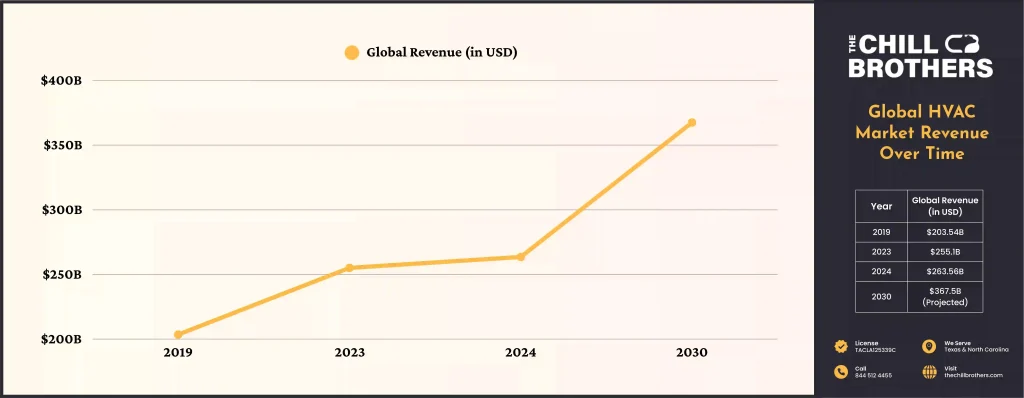
Globally, the HVAC industry had a revenue of $255.1 billion in 2023. The U.S. contributed $123 billion, sharing 48% of the total revenue. Last year, in 2024, the global revenue was $263.56 billion, and the U.S. (mostly North America) contributed $126.26 billion.
Compared to 2019, the global revenue was $203.54 billion.
With a 2.94% Cumulative Annual Growth Rate (CAGR), the global revenue is projected to be $367.5 billion by 2030.
Key drivers behind this huge growth are:
- Global temperatures (Temperature is expected to rise 1.5°C globally by the end of this decade)
- Growing demand for energy-efficient and eco-friendly systems (Technologies like heat pump operating at 400% efficiency, and reported only 48g CO2/kWh generation in the UK)
- Demand for smart technology (44% of realtors consider it a key feature)
- Increasing urbanization and construction activities (Global urbanization rate reaching 58% in 2025)
The Largest HVAC Companies In The World
The largest HVAC companies in the world are leading the market with both scale and revenue. Daikin Industries tops the list with around $36.3 billion in revenue, controlling roughly 15% of the global market, while Gree Electric Appliances follows with $29.2 billion.
Carrier Global dominates North America with $20.4 billion in revenue, and other major players like Midea Group, Trane Technologies, Johnson Controls (York), Mitsubishi Electric, and Lennox International each generate billions more. They combine a strong regional presence with smart technology and energy-efficient solutions to stay ahead in 2026.
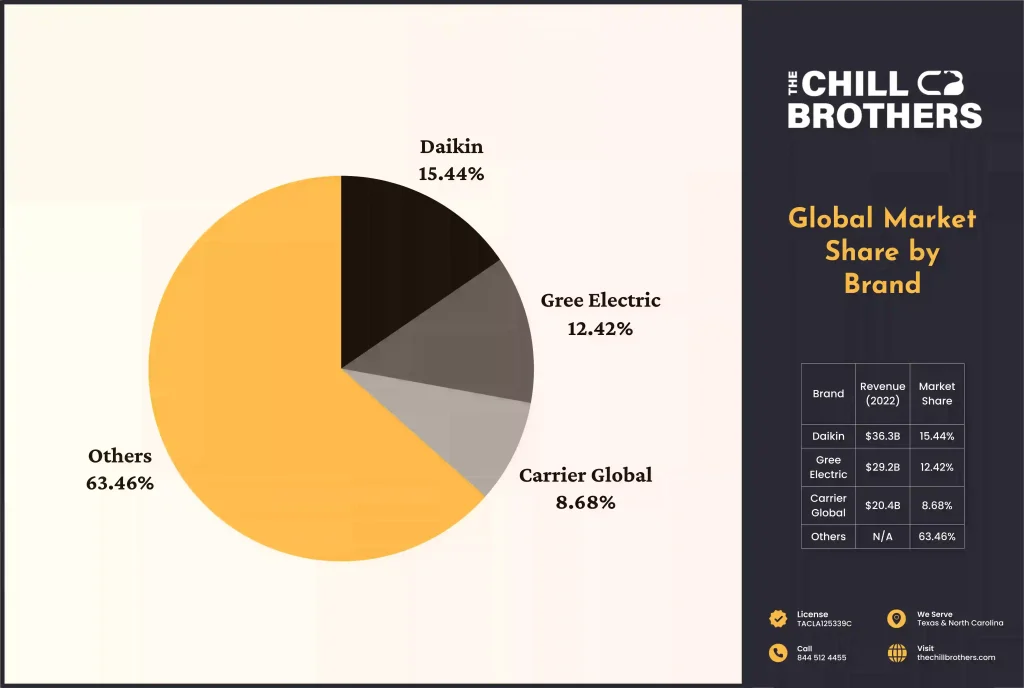
Daikin Industries, Gree Electric, and Carrier Global lead as HVAC brands globally in terms of generated revenue. Their generated revenue in 2022:
| Brand | Revenue | Market Share | Market Position |
| Daikin Industries | $36.3 billion | 15.44% | Global leader |
| Gree Electric | $29.2 billion | 12.42% | Dominates China |
| Carrier Global | $20.4 billion | 8.68% | Leader in North America |
Of course, the revenue share varies in different years. The leading brands also differ regionally. However, over the past few years, the leading brands across different regions were:
- North America: Carrier (17% share in 2016), Trane (10%), Lennox (8.2% in 2018).
- Europe: Bosch Thermotechnik ($5.75 billion revenue from Germany in 2023), Vaillant ($4.37 billion revenue in the same timeframe)
- Asia: Midea (16% of China’s HVAC revenue in 2023), Xiaomi (23% share of SEA)
Air Conditioner Market Share By Brand In 2026
At the center of this growth, Daikin Industries and Gree Electric Appliances continue to lead the global race. They still hold the positions because of their strong production capacity, global distribution, and continuous innovation.
But since global temperatures are rising rapidly, room air conditioners still account for nearly 65% of the market. Even the Asia-Pacific AC market is now 76.21 billion and projected to grow at a 5.63% CAGR by 2035.
Seeing the demand and opportunity, many brands are coming up with new technologies. Their affordability, ease of installation, and suitability for residential use make them the preferred choice for millions of households worldwide. However, the broader shift toward electrification and efficiency is also accelerating, as explained in this analysis of heat pumps vs air conditioning demand worldwide.
However, the competitive landscape is far from static. Several global and regional players are actively expanding their footprint, intensifying the race for dominance. Based on 2026 estimates, the market share distribution among top HVAC manufacturers looks like this:
| Rank | Brand | Market Share (2026 est.) |
| 1 | Daikin | 14–16% |
| 2 | Gree | 10–13% |
| 3 | Midea | 9–12% |
| 4 | Carrier | 5–9% |
| 5 | Trane | 4–5% |
| 6 | Johnson Controls | 3–4% |
| 7 | LG | 3–4% |
| 8 | Haier | 3–4% |
| 9 | Mitsubishi Electric | 2–4% |
| 10 | Hitachi | 2–3% |
| Others | Regional brands | 15–20% |
Regional Performance Deep Dive
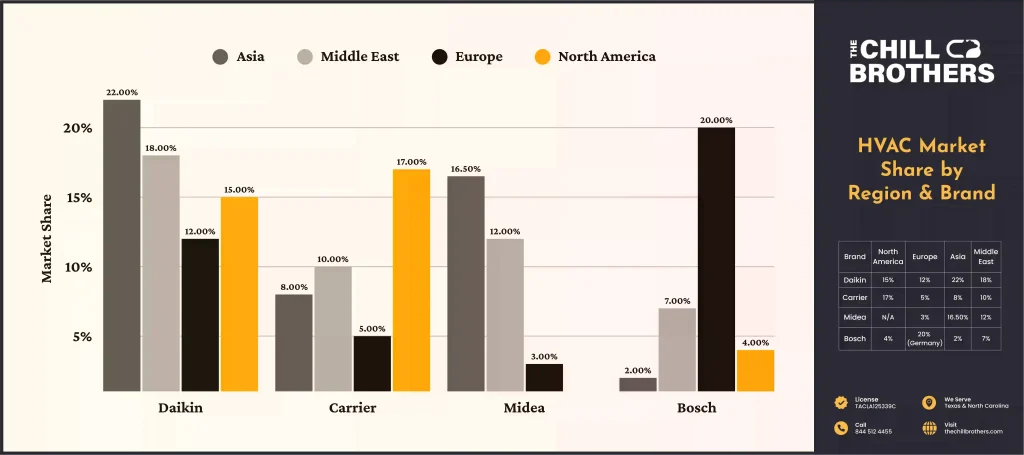
Daikin has its market share across all regions of the world. Other than that, each customer base has their own preference for HVAC manufacturers.
North America
In 2026, North America remains a major hub for HVAC growth, with the market expected to reach around $33 billion this year. The United States drives most of this demand, fueled by homeowners and businesses upgrading to energy-efficient systems, heat pumps, and smarter HVAC technology.
Several big names dominate the region: Daikin remains a global powerhouse with a strong North American presence, Carrier is still a household name for reliable heating and cooling, and Trane Technologies continues to shine in commercial spaces.
Johnson Controls leads with smart building solutions, while Lennox holds a solid spot in residential and light commercial systems. Other brands like Mitsubishi Electric also make their mark, especially with heat pumps and specialty units.
Together, these companies make up the backbone of the North American HVAC market, driving innovation and helping homeowners stay comfortable while saving energy.
Even with shifting incentives and new efficiency rules, these brands are finding ways to meet demand and keep the region cool, literally and figuratively.
Europe
Europe’s HVAC market is booming, with brands competing across air conditioners, heat pumps, and high-efficiency heating systems. In 2026, the region’s HVAC equipment market is estimated at around $32 billion, and a handful of major players are leading the charge.
- Daikin Industries takes the top spot, holding roughly 18–20% of the market. Their strength comes from heat pumps and air conditioners, backed by a strong European distribution network.
- Bosch Thermotechnik follows with about 10–12% share, generating nearly $4.8 billion in Europe alone. Their focus is on energy-efficient heat pumps, boilers, and hybrid systems.
- Vaillant Group captures 8–10% of the market, with several billion euros in annual sales, particularly in Northern and Western Europe.
- Mitsubishi Electric holds 6–8% market share, known for ducted heat pumps and commercial cooling solutions.
- Carrier Global takes around 5–7% of the market, supplying both commercial projects and residential heat pumps.
- Lennox International sits at 3–5%, mainly in residential air conditioning and packaged systems.
- Other brands, like Johnson Controls, LG, Panasonic, Viessmann, and Hitachi, share the remaining 30–35%, often focusing on regional or specialized markets.
Germany remains the largest single market in Europe, with the UK, France, Italy, and the Netherlands also contributing significantly.
Even amid fluctuations in heat pump sales in recent years, demand for energy-efficient systems continues to grow. All those are driven by stricter regulations and the push for greener, more sustainable heating and cooling.
Asia
Asia’s heating and cooling market continues to expand rapidly in 2026, with regional HVAC revenue now approaching $42–45 billion, driven by strong urbanization, rising temperatures, and growing interest in energy‑efficient systems.
The shift toward smart HVAC technology is especially evident in countries such as Japan, China, and India, where sustainability and connectivity are major priorities.
Brands from both inside and outside the region play key roles in shaping the market:
- Midea Group is one of the biggest names in Asia, holding roughly 16–18% of the regional market and generating revenue in the high $20 billion+ range. Their residential air conditioners remain especially popular across China.
- Gree Electric Appliances follows closely with around 14–16% share, backed by robust air conditioner sales and growing exports to other regions.
- Haier captures about 6–8% of the market, with strong year‑on‑year growth across South and Southeast Asia.
- Daikin Industries holds 7–9% share in Asia’s HVAC space, benefiting from strong heat pump and AC sales in Japan and neighboring markets.
- Hitachi maintains a solid presence, representing roughly 8–10% of regional HVAC revenue, especially in commercial cooling and VRF systems.
- Toshiba (including Toshiba Carrier) holds around 4–6% and continues to push smart HVAC and VRF solutions, particularly in India and Southeast Asia.
Together, these brands account for a major portion of Asia’s HVAC demand, with the rest shared by other global and regional players.
The region is also seeing more demand for smart controls, connected systems, and high‑efficiency heat pumps, as customers look to reduce energy costs and meet tightening environmental standards.
Middle East and Africa
The MENA (Middle East and North Africa) HVAC market continues to grow steadily in 2026, with total regional HVAC revenue now approaching $2.3 billion.
Rising temperatures, rapid urban development, and broader uptake of smart and energy‑efficient systems are driving demand across the region.
Air conditioning remains the heart of the market. The MENA air conditioner segment is now on track to exceed $480 million in 2026, while Africa’s standalone AC market is approaching $230 million.
Smart HVAC solutions featuring connectivity, efficiency, and predictive controls. Those are also gaining traction, with smart system sales in Africa alone expected to top $75 million this year.
Local manufacturers also play significant roles in their home markets:
- Zamil Air Conditioners (Saudi Arabia) continues to serve regional cooling needs with tailored AC systems.
- AirTech Riyadh responds to local demand with commercial and residential HVAC installations.
- FUJITSU GENERAL strengthens its presence in the UAE with energy‑efficient cooling solutions.
Across MENA, the trend is clear: as temperatures rise and buildings modernize, the market is shifting toward more efficient, smarter HVAC systems. They bring more choice and innovation to both customers and installers.

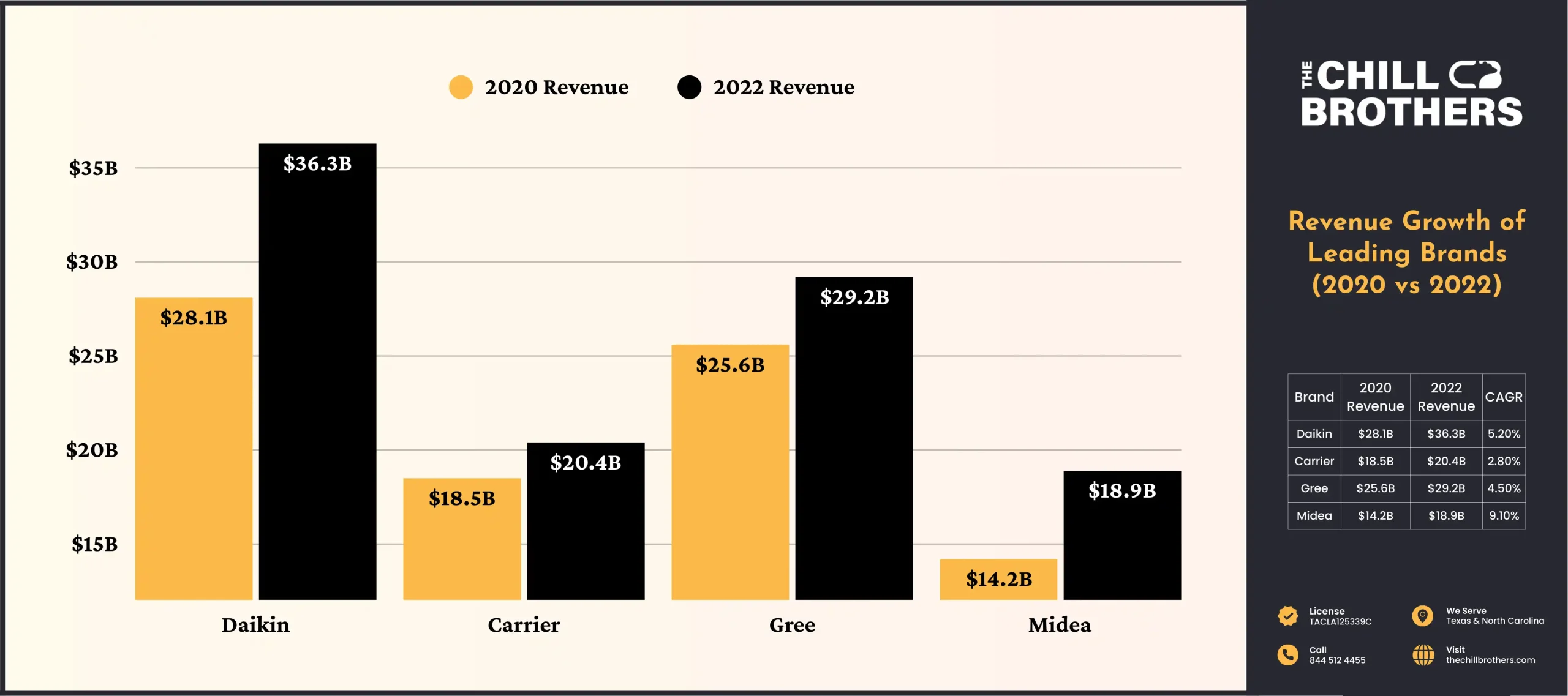
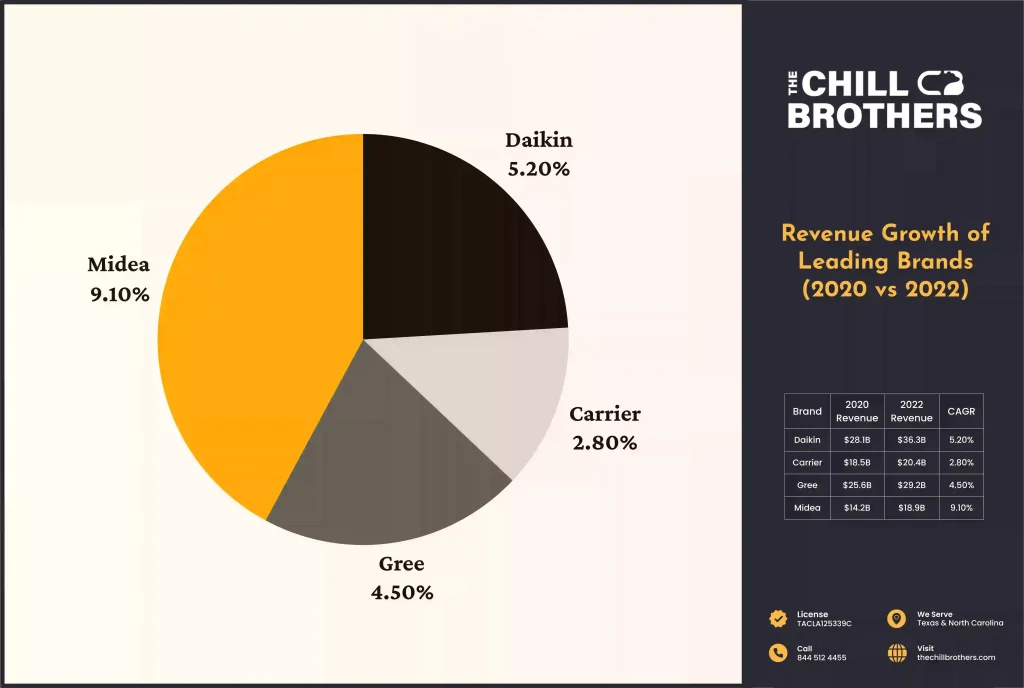
Daikin is the leading global HVAC manufacturer. They share most of the market as a single brand. However, Carrier shows the greatest potential in North America. On the other hand, Midea has the highest CAGR of 9.1% for the upcoming years.
Best HVAC Brands 2026
| Brand | 2022 Revenue | 2025–2026 Revenue (est.) | Estimated CAGR | Key Insight |
| Daikin | $36.3B | $26.5B (2025 HVAC equipment) | 5–6% | Continues as the global leader with strong technology and global scale; expanding heat pump and low‑GWP product lines |
| Carrier | $20.4B | $21.8B (2025 HVAC equipment) | 2.8–3% | Slower growth but still a dominant force in North America; strong commercial and decarbonization offerings. |
| Gree Electric | $29.2B | $21.8B (2025 AC) | 4.5% (2020–22) | China’s biggest AC maker, with a strong export push and IoT‑integrated products. |
| Midea | $18.9B | $13.2B (2025 HVAC equipment)* | 9.1% | Fastest organic growth, expanding smart and mass‑market HVAC globally. |
According to region, market penetrations of different brands are:
Emerging Trends
Most of a brand’s success in a region is based on the region’s trend and the features offered by manufacturers. Some of the trends dictating brand performance are:
Popularity of Heat Pumps
Heat pumps are heating some units reach 300–500%, and government incentives. These systems are attracting homeowners looking to lower energy bills while reducing their carbon footprint. Government incentives have helped accelerate adoption, although the recent end of U.S. federal tax credits poses some challenges for growth.
But still, air-source heat pumps (ASHPs) are becoming a favorite among homeowners, while geothermal systems are gaining popularity for year-round comfort.
- UK growth: 98,345 units sold, including air-to-air systems under the Boiler Upgrade Scheme (BUS).
- Challenges: Europe saw a 22% drop in sales in 2024, and U.S. federal tax incentives have ended.
- Environmental impact: Heat pumps cut greenhouse gas emissions by at least 20% compared to gas boilers.
Despite some hurdles, heat pumps are proving to be a smart, future-ready choice for cleaner, efficient heating.
AI & Predictive Maintenance
- 24.3% of industrial AI is used in predictive maintenance.
- Smart HVAC market to reach $5.47B by the end of 2025.
- 15% of U.S. AI climate startups focus on energy.
With the rise of AI technology, it has made its way into the HVAC industry.
The most notable use of AI in the HVAC industry has been in predictive maintenance. It is where the AI is being used to determine when maintenance should be performed. It accounted for 24.3% of the global industrial AI market.
The smart HVAC market, incorporating AI and IoT technologies, is projected to reach $5.47 billion globally by the end of 2025. Energy efficiency and climate change concerns are driving the growth of smart HVAC. AI-powered smart thermostats and other equipment can automatically regulate temperature for more energy-efficient usage. 15% of AI climate tech startups in the U.S. focus on the energy and power sector. So, we can expect more and more AI adoption for power savings and energy efficiency.
Sustainability
The HVAC industry has been focusing on reducing its carbon footprint for some time now. Increased sales of heat pumps are a clear indication of that.
In the Building Energy Act (2024), the German government mandated that 65% of new heating systems run on renewable energy by mid-2028 and 100% by 2045. Now, heat pumps account for 56% of the heating systems of EU building installations. Gas heating has already decreased by 10%.
Frequently Asked Questions (FAQs)
1. What is the biggest HVAC company in the world?
Daikin Industries is the world’s largest HVAC company by revenue and market share. In 2022, Daikin generated $36.3 billion in revenue and held approximately 15% of the global HVAC market. Gree Electric Appliances follows at $29.2 billion, and Carrier Global ranks third at $20.4 billion. Daikin’s dominance comes from its leading position in Japan, a strong European heat pump distribution network, and a growing presence in North American commercial markets.
2. What are the biggest HVAC companies in the US?
The biggest HVAC companies in the US are Carrier Global, Trane Technologies, Lennox International, and Johnson Controls (York brand). Carrier leads North American HVAC with approximately 17% regional market share. Trane holds around 10% and is especially strong in commercial HVAC. Lennox has approximately 8.2% of the North American market, focused on residential and light commercial. Daikin also has a growing US presence through its Goodman and Amana brands after its US acquisition.
3. What are the best HVAC brands in 2026?
The best HVAC brands in 2026 depend on your region and priorities. For North America, Carrier, Trane, and Lennox lead in reliability and service coverage. For heat pumps and high-efficiency systems, Daikin and Mitsubishi Electric are top choices. In Europe, Daikin and Bosch lead. For value and fast-growing smart home integration, Midea is worth considering. Globally, Daikin holds the most market share but Carrier remains the most recognized name in North America for residential systems.
4. Who are the top HVAC manufacturers by revenue?
The top HVAC manufacturers by revenue are: Daikin Industries ($36.3B), Gree Electric Appliances ($29.2B), Carrier Global ($20.4B), Midea Group ($18.9B), and Trane Technologies. These five companies collectively represent a significant share of the $333B global HVAC market. Midea is growing fastest at a 9.1% CAGR. Daikin maintains the top position through scale across all major regions, while Carrier and Trane dominate North American commercial markets.
5. What is the HVAC market share by brand in 2026?
Based on 2026 estimates: Daikin holds 14 to 16% of the global market, Gree holds 10 to 13%, Midea holds 9 to 12%, Carrier holds 5 to 9%, and Trane holds 4 to 5%. Regional shares differ significantly. Carrier leads North America at 17%. Midea leads China at 16%. Daikin leads Europe at 18 to 20%. These figures reflect total HVAC revenue, including heating, cooling, air handling, and ventilation products across both residential and commercial segments.
6. Is Daikin the largest HVAC company in the world?
Yes, Daikin Industries is the largest HVAC manufacturer in the world by revenue and global market share. With approximately $36.3 billion in annual revenue and a 15% share of the global market, Daikin leads every major region except China, where Gree and Midea dominate. Daikin’s global leadership comes from its origins as a Japanese industrial company, its early investment in inverter compressor technology, and its strategic acquisition of Goodman Manufacturing in the US in 2012, which gave it a major North American residential presence.
7. Which HVAC brands are considered the best for commercial buildings?
For commercial HVAC in North America, Trane Technologies, Johnson Controls (York), Carrier, and Daikin are the leading brands. Trane is especially strong in large commercial spaces like office buildings and data centers. Johnson Controls leads in building management and smart HVAC integration. For variable refrigerant flow (VRF) commercial systems, Daikin, Mitsubishi Electric, and LG are the top choices globally. For European commercial buildings, Daikin and Bosch dominate.
8. What are the fastest-growing HVAC brands in 2026?
The fastest-growing HVAC brand by revenue CAGR is Midea Group at 9.1%, driven by smart home integration, mass-market pricing, and global expansion across Southeast Asia and Latin America. Daikin is growing at a 5 to 6% CAGR, fueled by heat pump demand in Europe. Bosch and Vaillant are growing rapidly in Europe due to heat pump regulations. In North America, brands with strong heat pump product lines like Carrier and Trane are capturing market share from traditional furnace-only manufacturers.
Conclusion: Navigating the 2026 HVAC Landscape
For the past several years, Daikin has maintained global dominance, fueled by massive domestic demand in Japan and expanding footprints across Asia, Europe, and the U.S. While Midea leads the Chinese market and Carrier remains a household name in North America, the shift toward sustainable technology is redefining regional supremacy. In Europe, the surge in energy-efficient heat pump adoption has favored brands prioritizing “smarter” electrified systems.
Conversely, in warmer climates where cooling is the primary comfort driver, high-performance air conditioners still prevail. For homeowners in these regions, utilizing an AC size estimator is a critical first step in selecting a brand that handles local humidity without overspending on capacity. Ultimately, as 2026 regulations favor greener refrigerants, proactive homeowners can leverage programs like the HVAC Buy Back Program to transition into these modern systems while maximizing their return on investment.

I’m Francis Kaspar, a 35-year-old HVAC technician with over 10 years of experience in the industry. I hold a certification in HVAC technology from Texas State Technical College, where I gained hands-on skills that shaped my career.
Currently, I’m working at The Chill Brothers, specializing in AC installation, repair, and energy-efficient solutions. Outside of work, I enjoy spending time with my wife and two kids.
I’m also passionate about sharing my HVAC knowledge written by articles that provide practical tips and tricks for homeowners.



 Google
  Facebook
  Trustindex