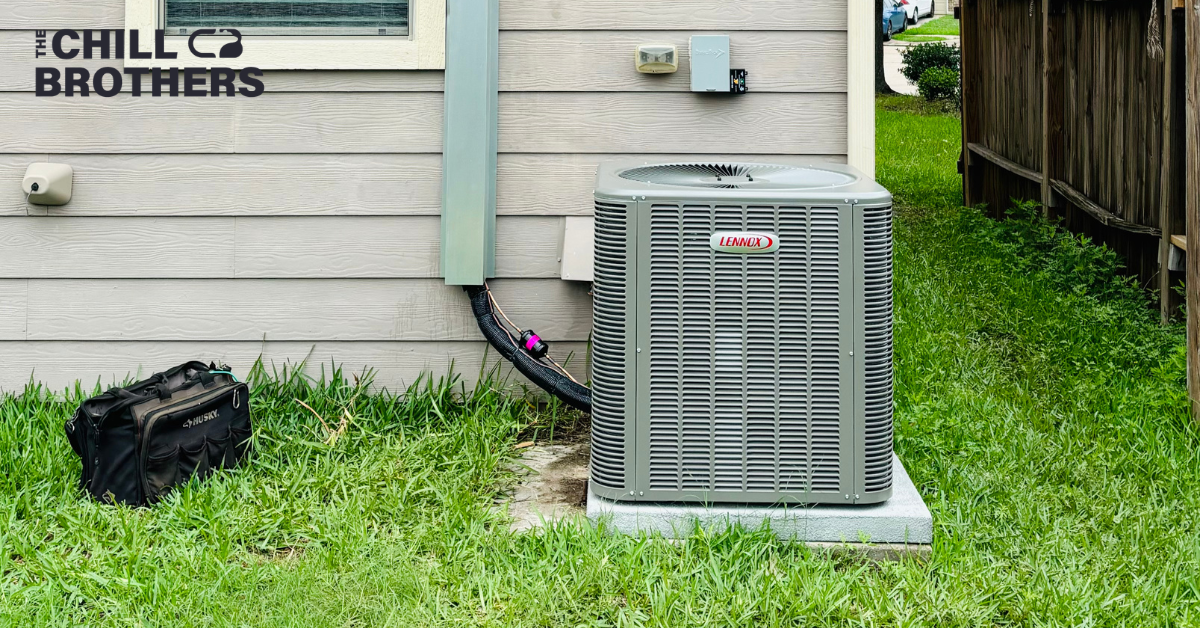
A 5 ton AC unit delivers 60,000 BTU of cooling per hour and is generally suitable for homes between 2,400 and 3,000 square feet. However, square footage alone is only a starting point. Factors like insulation quality, climate, ceiling height, window exposure, and home layout all affect whether a 5 ton system is the right fit.
Choosing the wrong size AC can lead to short cycling, poor humidity control, uneven temperatures, and higher energy bills. That’s why getting the perfect-sized AC for your home is so important. As experienced HVAC professionals, we’ve seen how a properly sized system improves comfort, efficiency, and long-term system life.
In this guide, you’ll learn how much space a 5 ton AC can cool, what sizing factors matter most, and how to determine whether it’s the best choice for your home.
Key Takeaways:
|
What Does A 5-Ton AC Unit Mean?
A 5-ton air conditioning unit does not indicate the weight of the unit. Instead, knowing the tonnage is essential for determining which air conditioner will be efficient in cooling your home. In HVAC terminology, Tonnage refers to the cooling capacity of the system. So, it indicates the amount of heat that is removed by the air conditioning system per hour.
1 Tonnage can remove 12,000 British Thermal Units (BTUs) every hour. Thus, a 5-ton AC can remove,
5 × 12,000 BTUs per hour = 60,000 BTUs per hour
As a 5-ton AC can remove quite a big range of heat from indoors, it has a higher capability of cooling. So, you can use this air conditioner in any large space. However, matching this significant cooling capacity with your home’s actual cooling demands is absolutely essential.
Guessing can lead to serious issues, which is why seeking professional assistance is always recommended to determine whether a 5-ton AC is truly a good fit for your specific needs.
Understanding The Cooling Capacity
Cooling capacity is the main factor to consider while selecting the right air conditioning system. The usual measure of cooling capacity is in British Thermal Units or BTUs. As a 5-ton AC unit delivers 60,000 BTUs of heat, it is undoubtedly a powerful unit.
However, your home’s cooling requirements are not solely dependent on its square footage. Various other factors significantly affect the actual cooling demands. These measures include:
- Layout of the house,
- Number of rooms,
- The amount of sunlight your home receives,
- Number of windows and their sizes,
- Height of the ceilings,
- Insulation condition of your home, including walls, attic, and ductwork etc.
Learn Energy Efficiency And SEER/SEER2 Ratings
While choosing any air conditioning system, including a 5-ton unit, evaluating its energy efficiency is critical. An energy-efficient system uses less power to deliver the same amount of cooling, which directly impacts your wallet and the environment.
Why Efficiency Matters
Choosing an energy-efficient AC unit translates directly into lower monthly energy bills and significant savings over the lifespan of your system. It also means your home is cooled using less energy overall.
Understanding SEER And SEER2
Energy efficiency is measured by ratings like SEER (Seasonal Energy Efficiency Ratio) and the newer SEER2. Think of these like miles per gallon for a car; a higher number means better efficiency.
SEER2 is the updated standard (as of 2023), designed to reflect more realistic operating conditions than the older SEER test.
Minimum SEER2 Standards By Region
To ensure you’re getting a reasonably efficient system, AC units must meet minimum SEER2 ratings, which vary by U.S. region. According to recent standards, the minimum required SEER2 rating for HVAC systems varies depending on your geographic region, the type of system (air conditioner or heat pump), and sometimes the cooling capacity:
| Region | System Type / Capacity | Minimum SEER2 Rating |
| North | Air Conditioners (All Types) | 13.4 |
| Southeast & Southwest | Split System Air Conditioners (< 45k BTU) | 14.3 |
| Southeast & Southwest | Split System Air Conditioners (≥ 45k BTU) | 13.8 |
| All Regions | Split System Heat Pumps | 14.3 |
Look For ENERGY STAR Certification
Beyond the minimum, look for the ENERGY STAR certification. This label indicates that the unit meets or exceeds strict energy efficiency guidelines set by the U.S. Environmental Protection Agency (EPA), signifying even greater performance and savings potential.
The Main Idea Here: Prioritize Higher Ratings
Always prioritize a 5-ton AC unit with the highest possible SEER2 rating that fits your budget, and look for the ENERGY STAR label. This ensures you get optimal cooling performance while maximizing energy savings and minimizing your environmental footprint.
Ideal House Size For A 5-Ton AC Unit
The main question arises on what size house a 5-ton AC unit can cool effectively? Though many factors affect this size, as mentioned earlier, here is the approximate size you can consider as a very general starting point but not a definitive answer.
The General Square Footage “Guideline”
Based on historical averages, a 5-ton air conditioner is sometimes considered suitable for homes ranging from 2,400 to 3,000 square feet. This is a common starting point for estimation, but it’s vital to recognize that relying only on square footage is a major oversimplification. Your home’s specific characteristics play a much bigger role.
More Important: Key Factors Influencing Suitability
While square footage provides a basic dimension, a 5-ton unit’s actual effectiveness is heavily determined by factors that affect how much heat your home gains. HVAC professionals always perform detailed calculations that account for these critical elements:
- Climate Zone: The heat and humidity of your region.
- Insulation & Home Sealing: How well your home retains conditioned air.
- Ceiling Height: The volume of air needing to be cooled.
Let’s look at why each of these is so important:
Climate Zone
The hotter and more humid your regional climate, the more cooling capacity your home will need. For instance, in hot climates like Texas, a 5-ton unit might be needed for a 2,400 sq ft home, whereas in milder climates, it could potentially cool a larger 3,000 sq ft home because the overall cooling demand is lower.
Insulation Quality & Home Sealing
Think of insulation as a barrier to heat transfer. Homes with excellent insulation in the attic, walls, and floors, along with properly sealed windows, doors, and ductwork, hold cool air much better. This reduces the cooling load, meaning a lower tonnage AC might be sufficient. Conversely, a poorly insulated home with air leaks will require a higher tonnage system to keep up, even if it’s the same square footage.
Ceiling Height
Air conditioners cool volume, not just square area. Homes with higher ceilings (10-12 feet) have significantly more air volume than those with standard 8-foot ceilings. This increased volume requires more cooling capacity to maintain comfortable temperatures, potentially necessitating a 5-ton unit for a smaller square footage home compared to a home with standard ceilings.
Therefore, while the 2,400-3,000 sq ft range offers a preliminary idea, these key factors, evaluated through a professional load calculation, are the true determinants of whether a 5-ton AC is the right size for your specific home.
Heat Pump Technology
While finding a 5-ton system, you can also consider a heat pump. Unlike an air conditioner, which only cools, a heat pump can provide both cooling in the summer and heating in the winter. This makes it a versatile and efficient year-round climate control solution.
A heat pump works by transferring heat from one place to another (out of the house in summer, into the house in winter), rather than generating heat by burning fuel. This thermodynamic process makes it a highly energy-efficient option compared to traditional furnaces.
So, consider getting a 5-ton heat pump with higher SEER/SEER2 ratings for cooling and higher HSPF (Heating Seasonal Performance Factor) ratings for heating to maximize energy savings and ensure year-round comfort.
5 Advanced Features In Modern 5-Ton ACs
While choosing a 5-ton air conditioning unit, look for modern models that incorporate advanced features and technologies. These can significantly improve comfort, efficiency, and system longevity, especially for a powerful unit like a 5-ton system managing large spaces:
1. Two-Stage Compressors
A two-stage compressor has two operating levels, high for peak heat days and low for milder conditions. This allows the system to run at a lower capacity for most of the time, providing more consistent temperatures, better dehumidification, and quieter operation than single-stage units.
2. Variable-Speed Technology
Even more advanced than two-stage, a variable-speed compressor can precisely adjust its cooling output in tiny increments to match the exact cooling demands of your home at any given moment. This results in the most consistent temperatures, superior humidity control, whisper-quiet operation, and maximum energy efficiency.
3. Smart Thermostats
Pairing your 5-ton AC with a smart thermostat offers enhanced control and efficiency. Smart thermostats learn your habits, can be controlled remotely via smartphone, optimize temperature settings based on occupancy or weather, and provide energy usage insights, leading to reduced energy consumption without sacrificing comfort.
4. High-Efficiency Air Handlers
The air handler (the indoor unit) plays a crucial role in distributing conditioned air. Choosing a high-efficiency air handler, often with a variable-speed fan, ensures consistent airflow, better air filtration (improving indoor air quality), and works synergistically with high-efficiency outdoor units for optimal system performance.
5. Split Systems And Zoned Cooling
Most residential 5-ton systems are split systems (with an outdoor compressor/condenser and indoor air handler). This configuration allows for incorporating zoning systems, where your home is divided into different areas, each with its own thermostat. Zoning allows you to independently control temperatures in different areas, ensuring comfort where needed and saving energy in unoccupied zones, particularly beneficial in large homes that might use a 5-ton unit.
3 Applications Of A 5-Ton AC Unit
Given its significant cooling capacity, a 5-ton AC unit is designed for spaces with high cooling demands. You can typically find this size unit in the following settings:
Large Residential Homes
Suitable for larger houses, especially those with open floor plans, high or vaulted ceilings, extensive glass windows, or homes in hotter climates with potentially higher heat gain.
Multi-Family Units
This size can sometimes be a match for cooling multiple units within a small duplex, triplex, or a large single apartment, depending on the cumulative load.
Light Commercial Buildings
Besides large residential spaces, a 5-ton AC unit is often used in small office buildings, retail stores, medical clinics, restaurants, or other light commercial applications where the cooling load matches the unit’s capacity.
However, it’s absolutely critical to remember that a professional load calculation is necessary to confirm if a 5-ton unit is the correct size for any of these applications.
2 Critical Risks Of Choosing The Wrong AC Size
Failing to accurately evaluate your home’s cooling needs and choosing an AC unit based on approximation alone can lead to incorrect sizing, either oversized or undersized. Both scenarios are detrimental and will lead to inefficiencies and various costly issues.
Oversizing Your AC Unit
If you install an AC unit that is too large for your space, it will cool the area too quickly and then shut off. This frequent turning on and off is known as “short cycling” and leads to different issues, including:
- Short cycling: The system doesn’t run long enough to complete a full cooling cycle.
- Poor humidity control: The system doesn’t run long enough to adequately dehumidify the air, leaving your home feeling cool but clammy.
- Inconsistent temperatures: Rooms can experience uncomfortable temperature swings.
- Reduced lifespan: The constant starting and stopping puts excessive wear and tear on components.
- Higher energy bills: The most inefficient part of an AC cycle is starting up. Frequent starts consume more energy overall.
Undersizing Your AC Unit
If you pick an AC unit that is too small for the required cooling load, the system will run almost nonstop in an attempt to reach the desired temperature, especially on hot days. This continuous operation will also lead to issues like:
- Constant operations: The unit struggles to keep up.
- Higher energy bills: Running continuously consumes a lot of power.
- Reduced indoor comfort: The house may never reach the set temperature, leaving you uncomfortably warm.
- Excessive wear and tear: Nonstop running wears out components faster.
- Frequent breakdowns: The overworked system is more prone to failures.
5 Tips For Choosing The Right AC Size
Selecting the appropriately sized AC is crucial for ensuring optimum comfort, maximum efficiency, and a longer lifespan for your system. Here are some expert-backed tips to help you choose the right AC size effectively:
- Prioritize a Professional Load Calculation (Manual J)
One of the most essential and reliable ways to choose the right size of AC is to incorporate a professional assessment. Hire us as a certified HVAC professional to assess your home specifications and local climate. They will take into account your home’s size, layout, insulation conditions, window and door types and numbers, local climate data, your household size, and other important details.
- Understand Manual J Is The Standard
Crucially, professionals use industry-standard methodologies like the ACCA Manual J, Residential Load Calculation. This comprehensive calculation determines your home’s specific heat gain and loss, providing the precise tonnage needed, far more accurate than relying solely on square footage guidelines.
- Get Multiple Estimates
While working with a trusted provider is key, obtaining load calculations and size recommendations from a couple of different qualified professionals can provide confidence in the assessment.
- Don’t Ignore SEER/SEER2 And Energy Star
While size is paramount, don’t forget efficiency. Always look for the highest SEER or SEER2 ratings you can afford, along with ENERGY STAR certifications. A right-sized, high-efficiency unit is the ideal combination.
- Consider Advanced Features
As discussed earlier, features like variable-speed compressors or smart thermostats can enhance comfort and efficiency, especially when paired with a properly sized system. Discuss these options with your HVAC professional.
Conclusion
A 5-ton AC can effectively cool large homes (typically around 2,400–3,000 sq. ft.) or light commercial spaces but square footage alone is never the whole story. Critical factors like insulation, window exposure, ceiling height, and layout all affect load requirements. And incorrect sizing can lead to higher bills, uneven cooling, and premature system wear.
For long-term savings, a professional Manual J load calculation is your best option. At The Chill Brothers, we help Texas homeowners choose the right system the first time, saving you from costly oversizing mistakes and keeping your space comfortable year-round. Reach us and we’ll help you get started.
Frequently Asked Questions (FAQs)
Is A 5-Ton AC Too Big For A 2,400 Sq. Ft. House?
Possibly. While 2,400 sq. ft. is on the lower end of the range for a 5-ton system, sizing depends on insulation, layout, and local climate. A Manual J load calculation is the only way to know for sure.
How Much Does A 5-Ton AC Cost With Installation?
Expect to pay $3,500–$7,500, depending on brand, SEER2 rating, ductwork complexity, and location. High-efficiency models may cost more upfront, but lower energy bills long term.
Can I Use A 5-Ton Unit For A Smaller House?
No. Oversizing causes short cycling, poor humidity control, and energy waste. If your home is under 2,200 sq. ft., consult a pro before considering a unit this size.
What Are The Signs My Current AC Is The Wrong Size?
Look for:
- Short cycling or constant running
- Uneven cooling across rooms
- High energy bills
- Sticky indoor air (humidity issues)
- Frequent maintenance problems
What’s The Best Way To Find The Right AC Size?
Hire a professional HVAC company to perform a Manual J load calculation. It considers all critical home factors- insulation, climate, layout, and prevents sizing mistakes.

I’m Francis Kaspar, a 35-year-old HVAC technician with over 10 years of experience in the industry. I hold a certification in HVAC technology from Texas State Technical College, where I gained hands-on skills that shaped my career.
Currently, I’m working at The Chill Brothers, specializing in AC installation, repair, and energy-efficient solutions. Outside of work, I enjoy spending time with my wife and two kids.
I’m also passionate about sharing my HVAC knowledge written by articles that provide practical tips and tricks for homeowners.